Have we seen this movie before?
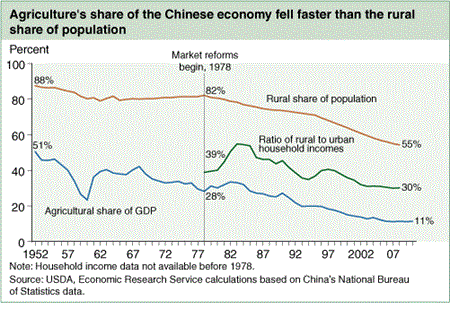
https://www.ers.usda.gov/amber-waves/2009/june/how-tightly-has-china-embraced-market-reforms-in-agriculture/ China was an agricultural country at the founding of the Peoples’ Republic in 1949. Nearly 90 percent of the people lived in rural areas, and half of Gross Domestic Product (GDP) came from agriculture in the early 1950s. The agricultural share of GDP declined to under 30 percent during the central planning period as economic planners promoted State-owned heavy industry. But the rural share of population remained over 80 percent until the 1970s. A rural-urban household registration policy prevented most rural people from moving to cities, and collective landownership tied farm families to their land. Following economic reforms in the 1970s, both the agricultural share of GDP and the rural share of population declined as urban economic growth outpaced rural growth. China’s large rural population with low productivity and low earnings is a legacy of policies that prevented rural-urban migration in earlier decades. In 2007, roughly half the country’s population still lived in rural areas. Most rural people are engaged in agriculture, a sector that produced only 11 percent of GDP in 2007. According to China’s 2006 agricultural census, the rural population was 746 million, including 342 million people engaged in agriculture on cropland totaling about 300 million acres. After improving during the early 1980s, rural income in China generally fell behind rapidly growing income in cities. By 2007, the average rural income was about 30 percent of the urban average. Officials, acutely aware of China’s history of rural-based rebellions, put top priority on raising farm income, modernizing agriculture, and restoring eroded rural social services under the rubric of “building a new socialist countryside” enshrined in the Government’s 2006-10 5-year plan. <a name='box2'></a>Grain Market Intervention CyclesChina’s grain market follows up-and-down cycles that reflect policymakers’ interventions. A 2007 report by a task force of Chinese grain officials, Research and Policy Recommendations on Controlling Grain Security Reserves, provides a rare glimpse of the country’s grain policies and trends in grain reserves. Chinese officials watch reserves carefully as an indicator of “food security.” China’s Government-managed grain reserves were below the Government’s threshold when reforms began. Officials raised grain procurement prices and imposed minimum grain-sale quotas on farmers to increase supply. By 1984, some regions began to experience grain surpluses for the first time. Buying stations flush with grain began to turn away farmers offering grain for sale at the government price. Soon, China’s grain market established an up-and-down cyclical pattern of aggressive policy inducements followed by grain surpluses, relaxed policies, and falling prices that lead to new shortfalls in production, followed by another round of aggressive grain policies. The cycle is evident in the historical trend in grain reserves and prices. In 1993, as the grain market was liberalized and the economy heated up, officials were alarmed when grain reserves fell to 23 percent of consumption. The Government doubled grain procurement prices during 1994-96, imported grain, and instituted a “Governor’s Grain Bag Responsibility” system that required each province to ensure adequate grain supplies. The result was a massive glut of grain. Grain reserves shot up to 62 percent of consumption in 1999, overwhelming grain warehouses. Prices plummeted, production fell, and imports ceased. China subsidized grain exports and industrial uses to liquidate 164 million metric tons of grain between 2000 and 2005. In 2003/04, officials were again alarmed when grain production slipped to 431 million metric tons and prices began increasing rapidly. Subsidy payments, protection prices, mechanization policies, and other inducements helped boost grain to a record 528 million metric tons by 2008. According to an article produced by China’s State Council in 2008, grain reserves averaged 35 percent of consumption. By late 2008, China had another glut of grain, and the Government increased its purchases of grain to prevent prices from falling.
 (7231FA96-1AA4-499E-BD20-74F99A524E77 (full).png) (7231FA96-1AA4-499E-BD20-74F99A524E77 (full).png)
Attachments
----------------
 7231FA96-1AA4-499E-BD20-74F99A524E77 (full).png (68KB - 221 downloads) 7231FA96-1AA4-499E-BD20-74F99A524E77 (full).png (68KB - 221 downloads)
| 
 Chinese grain purchases in 1990s and now.