|
|

| When you install a bearing, are you supposed to drive the locking collar on a bearing in the direction of bearing travel or the reverse direction? |
|
| |
|
| I was always told the direction of rotation if the shaft rotates and the opposite if the bearing (outer race) turns. Never seen an application where the shaft doesn't turn but the bearing does, but I suppose they exist. |
|
| |
|

Princeton, Indiana | I always tighten them in a "clockwise" direction so I know which way to hit it when I get ready to take it off again. Might not be correct but it works for me. |
|
| |
|
SE Iowa | Ask any two seasoned mechanics, and you are likely to get conflicting replies. |
|
| |
|
Shelbina, Missouri (NEMO) | I'm with Tumbleweed. I always install clockwise, so then I know which way to hit for removal.
Bill |
|
| |
|

Agent Orange: Friendly fire that keeps on burning. | Here's one for you -- my Sukup grain screener. The outer drum on this outfit turns one way and the inner turns the opposite. The contra-rotation is accomplished by using a ball bearing as a sort of planetary drive. Here's the front view of the drums: 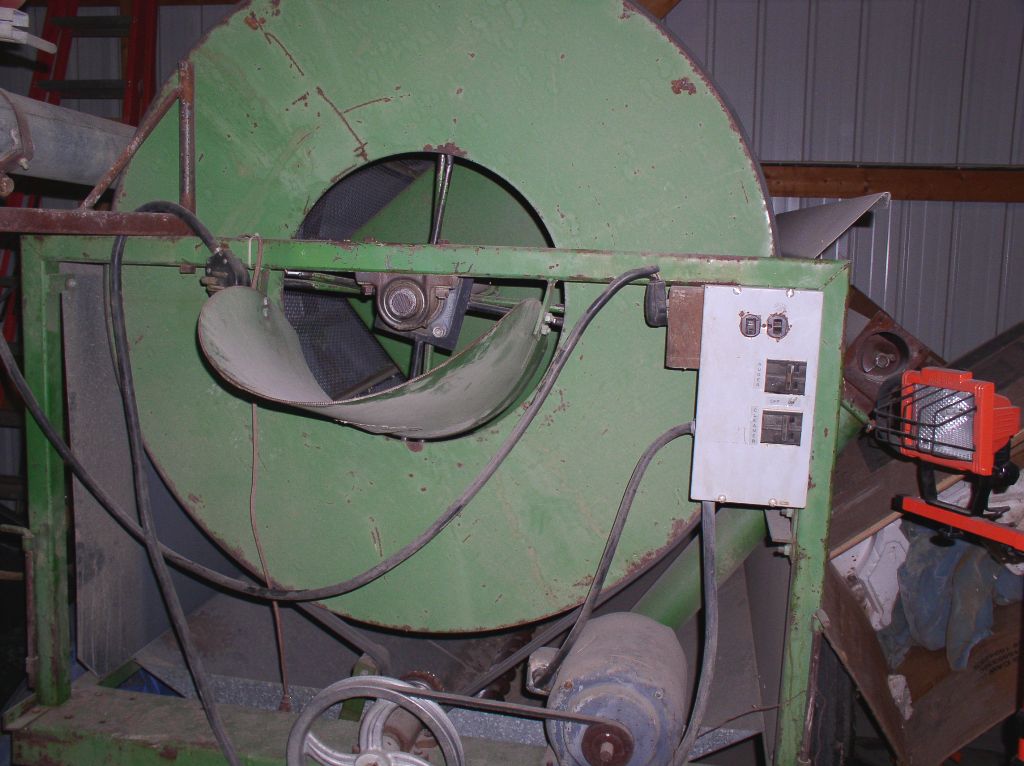
Notice that the outer drum is turned by two vee-belts that bear on the flat outer surface of the drum. The front of the drum is attached via four rods, to a plate that mounts the outer carrier of the ball bearing. The shaft that goes through the inner bearing is solidly attached to the inner drum, and that shaft is supported by a pillow block mounted ball bearing. Here's a close up of the support bearings and inner drum drive: 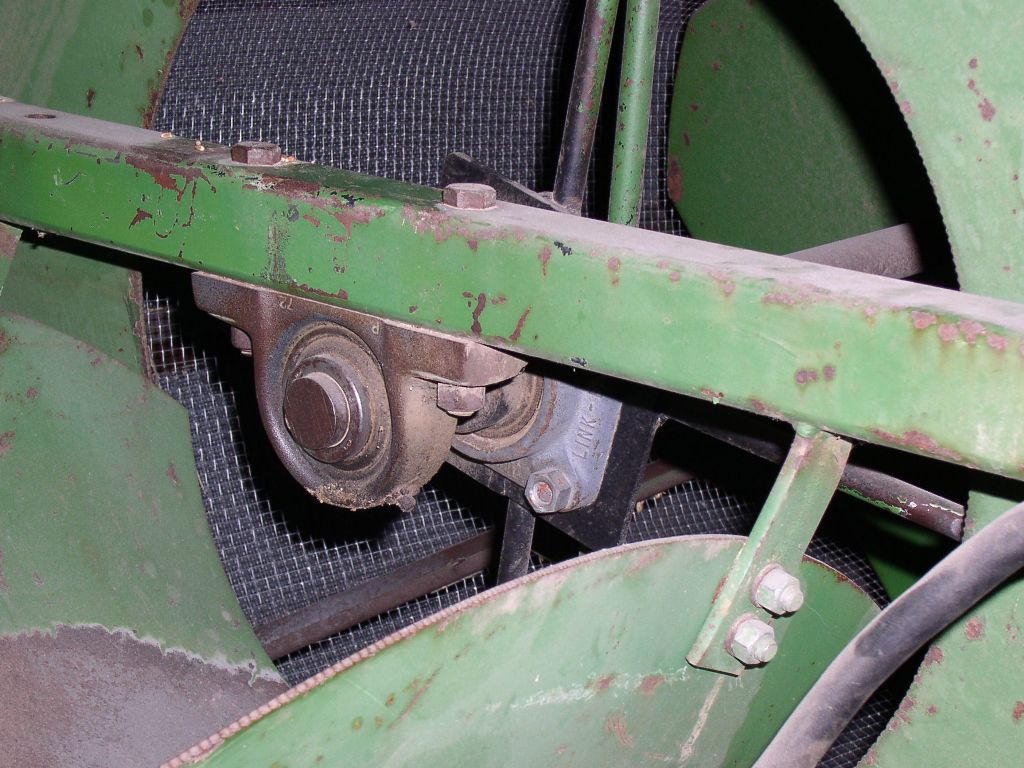
It took me a little time to figure out how they turned the drum backwards without using gears or pulleys/belts. |
|
| |
|
Agent Orange: Friendly fire that keeps on burning. | You need to ask yourself what happens if the bearing starts to drag. If you have tightened the lock collar in the direction the shaft rotates, then a sluggish bearing will tighten itself even more, against the lock collar. If you've tightened it the wrong way, excessive drag could loosen the bearing in the lock and allow it to spin on the shaft and ruin it or cause a fire, before you noticed it. |
|
| |
|

| IIRC, a couple sets of those bearings are inside a roller where the inside portion of the bearing is stationary and the outside turns with the roller. |
|
| |
|
Oregon | Ed is correct, you should always tighten the collar in the direction that the shaft turns. You should also be careful to not excessively overtighten the collar with your punch. I knew a John Deere mechanic who would barely tap the collar and then set the set srew. His theory was if the collar moved a little it would just tighten itself. |
|
| |
|
| Yes, lock the collar in the direction of shaft rotation. I've had them work loose from having done the opposite...
It's not hard to remember which way the collar is locked if you know which way the shaft turns.
Rod |
|
| |
|
NE Mo | I know which way I tighten the collar, but don't know which way the last guy tightened it. Even new from the factory you will find them tightened both ways. |
|
| |
|

Leesburg, Ohio | You can usually tell which way the last guy tightened it by looking at the punch mark.
If you guys mean, if the shaft rotates clockwise, to tighten the collar clockwise, then I don't do it that way. I tighten against the rotation (if shaft turns clockwise, I tighten counterclockwise) so the rotation of the shaft is not trying to loosen the bearing. |
|
| |
|
Agent Orange: Friendly fire that keeps on burning. | It might sound wrong, so you really need to get a bearing and collar and see how this works. Slip the bearing on the shaft and then put the lock on and barely tighten it by hand, the way you're doing it. Now hold the collar and turn the shaft and inner race like the bearing was starting to sieze. If you've tightened opposite the rotation, the collar will loosen. If you've tightened with the rotation, the collar will get tighter if the bearing tries to slip on the shaft. I know, I know - it sounds wrong, but in this case, the wrong way is really the right way  |
|
| |
|

Brazilton KS | I've heard this argument a hundred times.
It doesn't make any difference. |
|
| |
|

Hagen Brothers farms,Goodrich ND | I read in several shop /operators manuals to tighten the lock collar in the same direction as shaft rotation.
I never really understood why until I realized that the collar locks to the shaft with the set screw, not the bearing.
If the bearing slips on the shaft, it will move opposite shaft rotation.
Tightening the lock collar in the direction of shaft rotation will self tighten if the bearing slips on the shaft.
If you tighten the collar opposite shaft rotation, then any bearing slippage will loosen the collar.
Edited by Jon Hagen 6/8/2008 14:31
|
|
| |
|

Aberdeen MS | Only for trying to remember which way to start tapping to take it off.
The eccentric on the bearing inner race isn't threaded like bolt or pipe. The lock collar set screwed tight to the shaft with go to the other extreme of the eccentric and be tight. As long as the collar stays tight on the shaft, it makes no nadda.
Around here, when the set gets to the point of replacing it's the gas ax anyway. But there are times when the two do seperate and you just have to then deal with the bearing itself.
Now my dad would scream bloody murder about using a new lock collar, one would "save" that in the event the old one you put on with the new bearing failed, that way you have a spare.
The old ones do make a nice spacer in some instances tho. |
|
| |

 locking collar on bearing - which way do you tighten?


