|
|
| I'm just trying to get an idea of what the RTK market looks like. I'm interested mainly in positioning only at the moment, not the automatic guidance and such. Here's what I've read:
If you have an RTK network available, you can pay a few thousand dollars a year for access. If you don't, you can purchase a base station for around 10-40k. In order for a piece of machinery to get position data, it requires a receiver that is somewhere around $5000.
Does a subscription typically cover just one receiver? Do you need anything other than a receiver to get position data? Do the receivers give you your heading, pitch, or roll, or do you need something else to provide that?
If anyone can give actual prices on some of this stuff, I'd definitely appreciate it. Or anything else that I should know. Thanks! |
|
| |
|

Agent Orange: Friendly fire that keeps on burning. | Are you looking at new or used? Big difference in prices.
So you just want positioning. What then? It is a huge waste of money to have an RTK setup and only use it as a lightbar.
We are sparsely populated here so no networks to subscribe to. As for subscriptions, It is my understanding that some suppliers make a deal as the number of receivers each farmer has goes up.
I use a Trimble EZ-Guide 500 receiver. It will display heading, roll, lat, long.
In order to get the 500 to receive RTK, it needs an antenna that receives on both the L1 & L2 bands. It has to be unlocked to first Omnistar and then to RTK. Sticker price on the unlocks is $2K each or $4K to get from WAAS to RTK. Then in order to get RTK, I needed to buy an RTK base station and set that up in a position that had an un-obstructed view of the skies. Needed to be very stable also so this is the mounting point for the station and antenna:
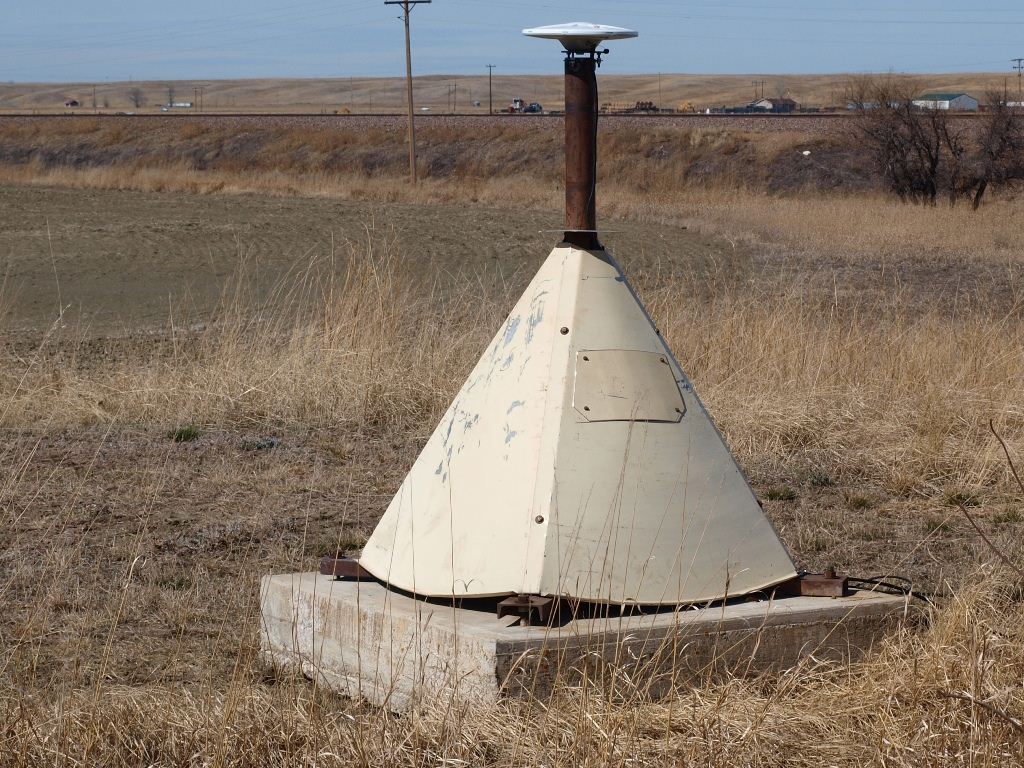
Once you have corrections data, that needs to be communicated to the receivers in the roving equipment. My base station also included a 900 MHz transmitter so I needed to provide a tower and antenna that would broadcast the signal to all parts of my farm. I used an existing tower and mounted the corrections antenna on that:

Then once the corrections data is broadcast, the rovers need an additional radio to receive the corrections data. Several different radios to accomplish that and prices for those vary.
I started with a 500 unlocked to Omni*. By the time I got the RTK unlock, a used rover radio, data/power cable & antenna for the 500, and then an old unused base station with antenna, cable & wire to hook up to the 900 MHz antenna on the tower I was still under $10K. My base station will supply corrections data to as many receivers as I want and as far as that goes, if the neighbors wanted to use it, they'd be welcome to it at no cost because I'm doing it for myself anyways and it doesn't cost me any extra to share it.
One other item: once the 500 was unlocked to and receiving RTK, it also displays distance from the base in cm, distance south of the base and distance east of the base in cm too. |
|
| |
|
| Is the base station a Trimble? Does it have to be or can you "mix and match" components to work with a 500? If so what else would work for a base? |
|
| |
|
Agent Orange: Friendly fire that keeps on burning. | Yes the base is a Trimble AGGS RTK 900.
I think other base stations will send corrections that a 500 can use but I can't say for sure. |
|
| |
|
| Thanks very much for the info and pictures. So just to clarify, the sticker price for the subscriptions is about $4,000 to get RTK, and the price of the receiver varies greatly based on used or new? Could you give me an idea of how much the receiver might be (used or new)?
I don't suppose you know how the receiver calculates its heading or roll, and how accurate it is? I figure there must be a separate sensor or something. I know you can get heading data from GPS if you use two receivers, but I assume there aren't two in each unit.
I'm in school working on a thesis about using cameras to get position and I'm trying to compare it to RTK systems, that's why I'm just interested in positioning. Thanks again for the info, it's very useful because none of the suppliers provide pricing information. |
|
| |
|
Missouri | subscriptions probably vary in price according to where you are at in the world or what state you are in. I am doubting you could get a brand new antenna that was unlocked for rtk for 5000 bucks. You can get a heading off of one antenna but it depends on what system you are talking about on how it gets its roll. trimble uses the nav II controller to get the roll, ag leader paradyme uses the two antenna system for roll and deeere uses a gyro in the antenna for roll. It really depends on what system you are looking at or working with on price and how they get the information for there rtk system. |
|
| |
|
South Dakota | For strictly receiving RTK corrections on the Raven side you are looking around 9K initial cost for an RTK reciever, Slingshot cell modem, and 3 year Slingshot CORS hookup fee. If you do not have a CORS network you will need a basestation and that can get spendy pretty quick. However, depending what you are doing and how many acres (striptilling for instance) it can pay for base pretty quick also. For 3D comp, most companies put that in the steering module and not the receiver... |
|
| |
|
Agent Orange: Friendly fire that keeps on burning. | A good source of pricing info is eBay or the classifieds on AT+.
I think what you are referring to as a subscription is more accurately called a one time fee to unlock the receiver to the desired level of accuracy. I see quite a few used 262 receivers that are unlocked to RTK for somewhere around the $3K mark. A used 900 MHZ corrections receiver can be bought for less than $1K.
Trimble receivers don't have a clue about heading until you start moving. They then calculate it by comparing where they currently are to where they used to be. Those calculations are done very frequently -- 10 Hz or so and are as accurate as your correction source and displayed to 3 decimals of a degree.
Pitch, roll, and yaw are done via a steering control box. The EZ-Steer controller contains two accelerometers and two solid state ring gyros that compute roll and yaw. The NAV II and EZ-Pilot controllers use three accelerometers and ring gyros to compute pitch, roll, and yaw.
As far as accuracy comparisons to cameras or lasers, I'd put my money on a good RTK system with a nearby base station. Light refracts and causes inaccuracies when temps and humidities are uneven over the ranges you are measuring. |
|
| |
|
| Ok, that makes sense. Heading is done the same way with the low cost GPS units for cars and such.
Yeah, visible light refracts more than radio, but radio reflects off pretty much anything while visible light would need a very smooth surface like standing water. I know reflections are an issue with GPS, but maybe not so much with RTK GPS. With what we're doing with cameras, we're going to need a "base station" (really just a light source) every 100-200 yards anyway, so I don't think refraction would be much of an issue. RTK is incredible technology, but I think the camera stuff could have some uses worth exploring. Maybe.
Thanks again Ed, and also arg1333 and Born2farm. This is very helpful.
Edited by murrdpirate 6/27/2012 10:37
|
|
| |

 Brief overview/costs of RTK positioning systems?


