The one thing that must be clear is that we live in economy that over the last 25 years(which rapidily escalated in the last 10 years) is the fact that Credit or debt supplanted real money(m1, m2 etc.) as a medium of exchange and base money growth regardless of how big cannot supplant the erosion of credit that is taking place, I'll let the economist Steve keen explain. "The point made by endogenous money theorists is that we don’t live in a fiat-money system, but in a credit-money system which has had a relatively small and subservient fiat money system tacked onto it". "We are therefore not in a “fractional reserve banking system”, but in a credit-money one, where the dynamics of money and debt are vastly different to those assumed by Bernanke and neoclassical economics in general.[10]" The following is from Steve Keen, and looks at money supply growth vs debt and the conclusions he draws from his work. The full article can be found at, http://www.debtdeflation.com/blogs/2009/01/31/therovingcavaliersofcredit/ "Ben Bernanke, a leading neoclassical theoretician, and unabashed fan of Milton Friedman, is now in control of the Federal Reserve. He is therefore trying to resolve the financial crisis and prevent deflation in a neoclassical manner: by increasing the Base Money supply. Give Bernanke credit for trying here: the rate at which he is increasing Base Money is unprecedented. Base Money doubled between 1994 and 2008; Bernanke has doubled it again in just the last 4 months. 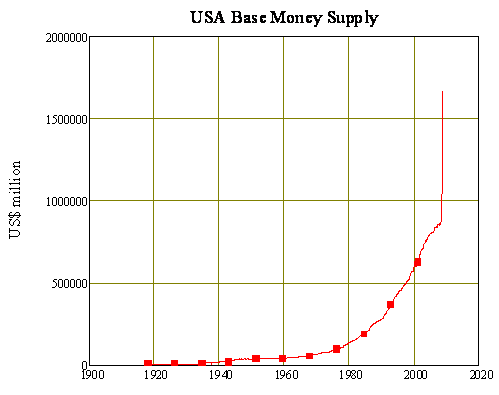
If the money multiplier model of money creation were correct, then ultimately this would lead to a dramatic growth in the money supply as an additional US$7 trillion of credit money was gradually created. 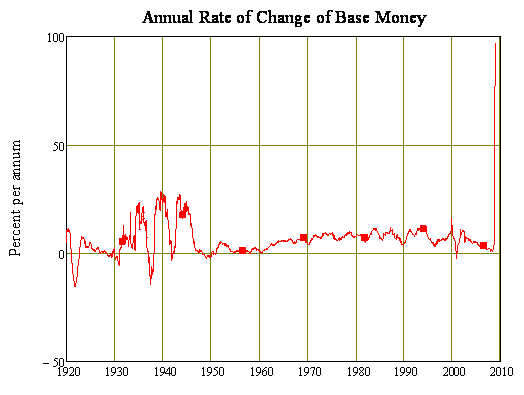
If neoclassical theory was correct, this increase in the money supply would cause a bout of inflation, which would end bring the current deflationary period to a halt, and we could all go back to “business as usual”. That is clearly what Bernanke is banking on: “The conclusion that deflation is always reversible under a fiat money system follows from basic economic reasoning. A little parable may prove useful: Today an ounce of gold sells for $300, more or less. Now suppose that a modern alchemist solves his subject’s oldest problem by finding a way to produce unlimited amounts of new gold at essentially no cost. Moreover, his invention is widely publicized and scientifically verified, and he announces his intention to begin massive production of gold within days. What would happen to the price of gold? Presumably, the potentially unlimited supply of cheap gold would cause the market price of gold to plummet. Indeed, if the market for gold is to any degree efficient, the price of gold would collapse immediately after the announcement of the invention, before the alchemist had produced and marketed a single ounce of yellow metal. Like gold, U.S. dollars have value only to the extent that they are strictly limited in supply. But the U.S. government has a technology, called a printing press (or, today, its electronic equivalent), that allows it to produce as many U.S. dollars as it wishes at essentially no cost. By increasing the number of U.S. dollars in circulation, or even by credibly threatening to do so, the U.S. government can also reduce the value of a dollar in terms of goods and services, which is equivalent to raising the prices in dollars of those goods and services. We conclude that, under a paper-money system, a determined government can always generate higher spending and hence positive inflation… If we do fall into deflation, however, we can take comfort that the logic of the printing press example must assert itself, and sufficient injections of money will ultimately always reverse a deflation.” [8] However, from the point of view of the empirical record, and the rival theory of endogenous money, this will fail on at least four fronts: 1. Banks won’t create more credit money as a result of the injections of Base Money. Instead, inactive reserves will rise; 2. Creating more credit money requires a matching increase in debt—even if the money multiplier model were correct, what would the odds be of the private sector taking on an additional US$7 trillion in debt in addition to the current US$42 trillion it already owes?; 3. Deflation will continue because the motive force behind it will still be there—distress selling by retailers and wholesalers who are desperately trying to avoid going bankrupt; and 4. The macroeconomic process of deleveraging will reduce real demand no matter what is done, as Microsoft CEO Steve Ballmer recently noted: “We’re certainly in the midst of a once-in-a-lifetime set of economic conditions. The perspective I would bring is not one of recession. Rather, the economy is resetting to lower level of business and consumer spending based largely on the reduced leverage in economy”.[9] The only way that Bernanke’s “printing press example” would work to cause inflation in our current debt-laden would be if simply Zimbabwean levels of money were printed—so that fiat money could substantially repay outstanding debt and effectively supplant credit-based money. Measured on this scale, Bernanke’s increase in Base Money goes from being heroic to trivial. Not only does the scale of credit-created money greatly exceed government-created money, but debt in turn greatly exceeds even the broadest measure of the money stock—the M3 series that the Fed some years ago decided to discontinue. 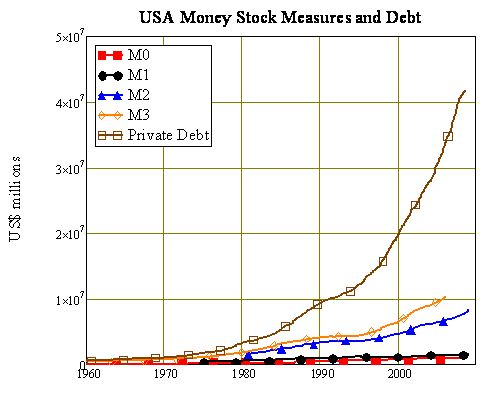
Bernanke’s expansion of M0 in the last four months of 2008 has merely reduced the debt to M0 ratio from 47:1 to 36:1 (the debt data is quarterly whole money stock data is monthly, so the fall in the ratio is more than shown here given the lag in reporting of debt). 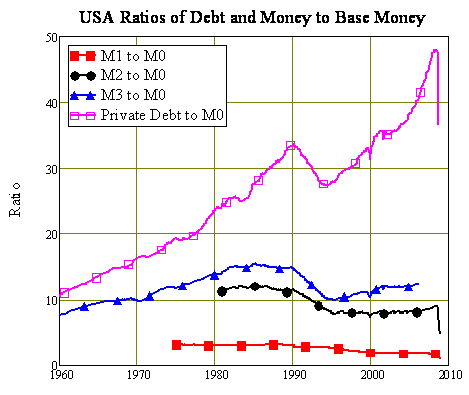
To make a serious dent in debt levels, and thus enable the increase in base money to affect the aggregate money stock and hence cause inflation, Bernanke would need to not merely double M0, but to increase it by a factor of, say, 25 from pre-intervention levels. That US$20 trillion truckload of greenbacks might enable Americans to repay, say, one quarter of outstanding debt with one half—thus reducing the debt to GDP ratio about 200% (roughly what it was during the DotCom bubble and, coincidentally, 1931)—and get back to some serious inflationary spending with the other (of course, in the context of a seriously depreciating currency). But with anything less than that, his attempts to reflate the American economy will sink in the ocean of debt created by America’s modern-day “Roving Cavaliers of Credit”. 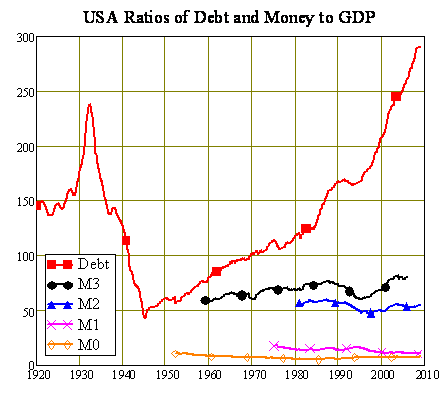
How to be a “Cavalier of Credit”Note Bernanke’s assumption (highlighted above) in his argument that printing money would always ultimately cause inflation: “under a fiat money system“. The point made by endogenous money theorists is that we don’t live in a fiat-money system, but in a credit-money system which has had a relatively small and subservient fiat money system tacked onto it. We are therefore not in a “fractional reserve banking system”, but in a credit-money one, where the dynamics of money and debt are vastly different to those assumed by Bernanke and neoclassical economics in general.[10]
Edited by zenfarm 2/19/2009 22:26
| 
 Debt and deflation


